
Building A Prototype
Based on what I wanted to do (see “The Idea?”) and based on the fact I stayed well within my comfort zone in the ideation phase, I decided to try something different when building the prototype. I was still going to build the prototype in the tool I’m most used to for 2D, Game Maker Studio 2, 1 but I decided to change the timescale.
Challenging Myself
As some of you may know I used to attend local Norfolk demo parties when I was younger, which tended to take place over a single weekend. So, having never actually attended a GameJam, I decided to treat the development of the prototype as my own personal GameJam, and gave myself an imaginary two, twelve hour days (24 hours) to write the prototype.
Validation – Is This Possible?
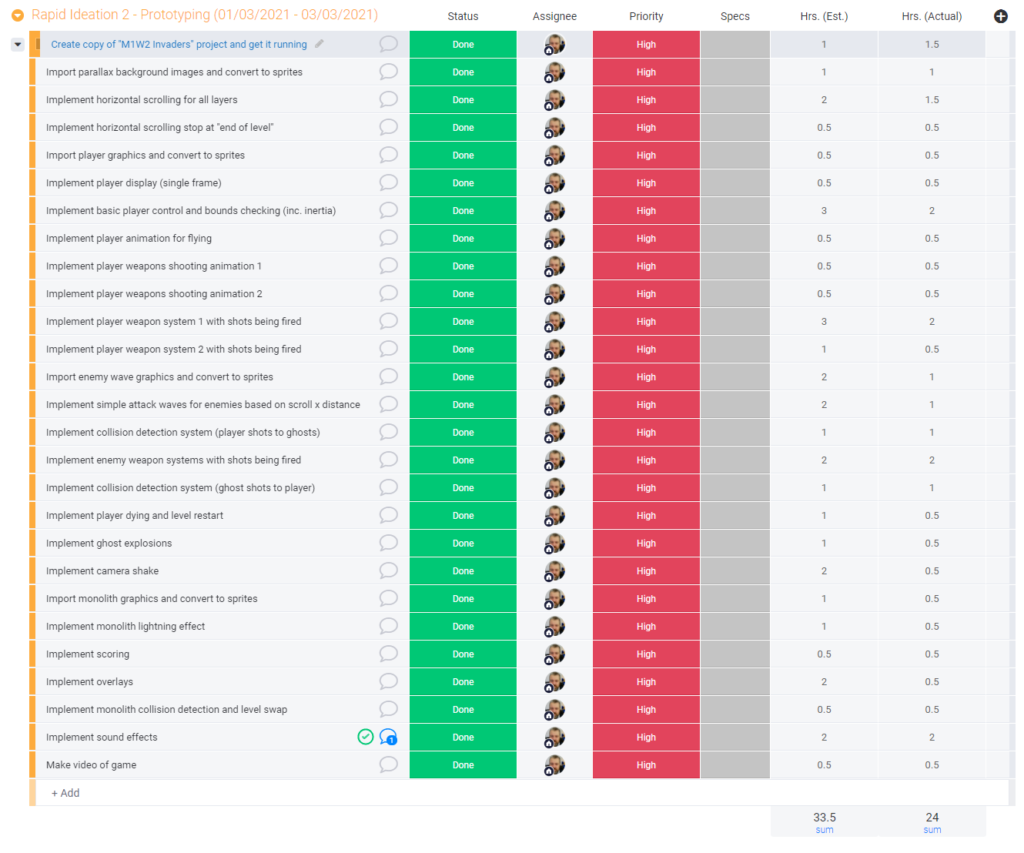
Of course, just giving an arbitrary timescale isn’t ideal, so what I did before hand was use a board on Monday.com to plan the development based on experience and the plan I had in my head from the mind map I had created.
A snapshot of this finished board is below. Spoiler alert. It shows estimated time and actual time taken. I know it might seem convenient, but I had to cut corners to get it to fit in the 24 hours I gave myself.
With the schedule in place I decided to cheat a little and search for assets before I started. All of the art assets I used were purchased from one of the two websites below:
Timescale
So, the timescale I gave myself was:
- 06:00 to 08:00 on Monday 1st March 2021 (2 hours)
- 17:00 to 01:00 on Monday/Tuesday 1st/2nd March 2021 (8 hours)
- 06:00 to 08:00 on Tuesday 2nd March 2021 (2 hours)
- 17:00 to 01:00 on Tuesday/Wednesday 2nd/3rd March 2021 (8 hours)
- 06:00 to 08:00 on Wednesday 3rd March 2021 (2 hours)
- 16:00 to 18:00 on Wednesday 3rd March 2021 ( 2 hours)
I had cleared a certain amount of critical items at work to allow me to do this pretty much uninterrupted.
Prototyping
Having written a number of published games over the years, and having written a lot of prototypes of both games and business applications, this, unfortunately, is the boring part.
The development of the prototype went pretty much as planned with some items being done quicker than expected, some slower.
I did have to scale back on a few things though, and the finished artefact/prototype consisted of the following elements:
- Parallax scrolling background (5 layers, 6 tile sets, left to right)
- Controllable character (flying animation)
- Two methods of character attack using spinning scythe (attack animations)
- Simple random ghost waves (ghosts fade in and fade out, simple animation)
- Ghost fireball attacks (animation)
- Simple collision detection between player and ghost fireballs
- Player dying animation and level restart
- Simple collision detection between player attacks and ghosts
- Ghost dying effect
- Screen/camera shake
- Floating monolith transported at end of level
- Lightning effect from top of screen to top of monolith
- Simple collision detection between monolith and player
- Transition to the next level
- Sound effects (7 in total I think)
- Background music
Reflection
Although I wanted to challenge myself, I think I may have took it too far. My day job sees me working with a lot of local authorities, who at this time of year are trying to spend their budgets, which makes March the busiest month of the year.
The time constraints I gave myself were reminiscent of the crunch periods in the games industry, which back then I actually enjoyed. Now I’m a lot older, but apparently not wiser, it was more of a struggle. It was however, enjoyable.
Some of the prototyping was a case of “winging it”, but that’s part of the fun of it, but there are aspects I should have been more concrete on. For example, simple player movement is very, very easy, but it didn’t feel right, so I implemented an inertia system. For a prototype I should not have really gone to this detail.
The Result?
I am working on getting the prototype uploaded to my website so it can be played, but in the meantime the video below gives a brief taster of what it looks and sounds like.
The prototype actually runs at a 1920 x 1080 resolution, so this video does not really do it justice.
SMART Outcomes
Specific
I believe I outlined a specific goal in my prototype schedule, which I pretty much kept to, and was in line with my initial mind map.
Measurable
The measurable outcome right now is only the video, but when a playable version is uploaded this will become more apparent and obvious.
Achievable
The whole reason I produced an initial schedule was so that I could gauge whether it was achievable. Although I gave myself a tight deadline I am pretty happy with what I achieved given the constraints.
Relevant
I think the “finished” (what is finished anyway) prototype largely conforms to what my plan was, and is largely in line with the mind map.
Time-Oriented
I think this has been explained in enough detail.